
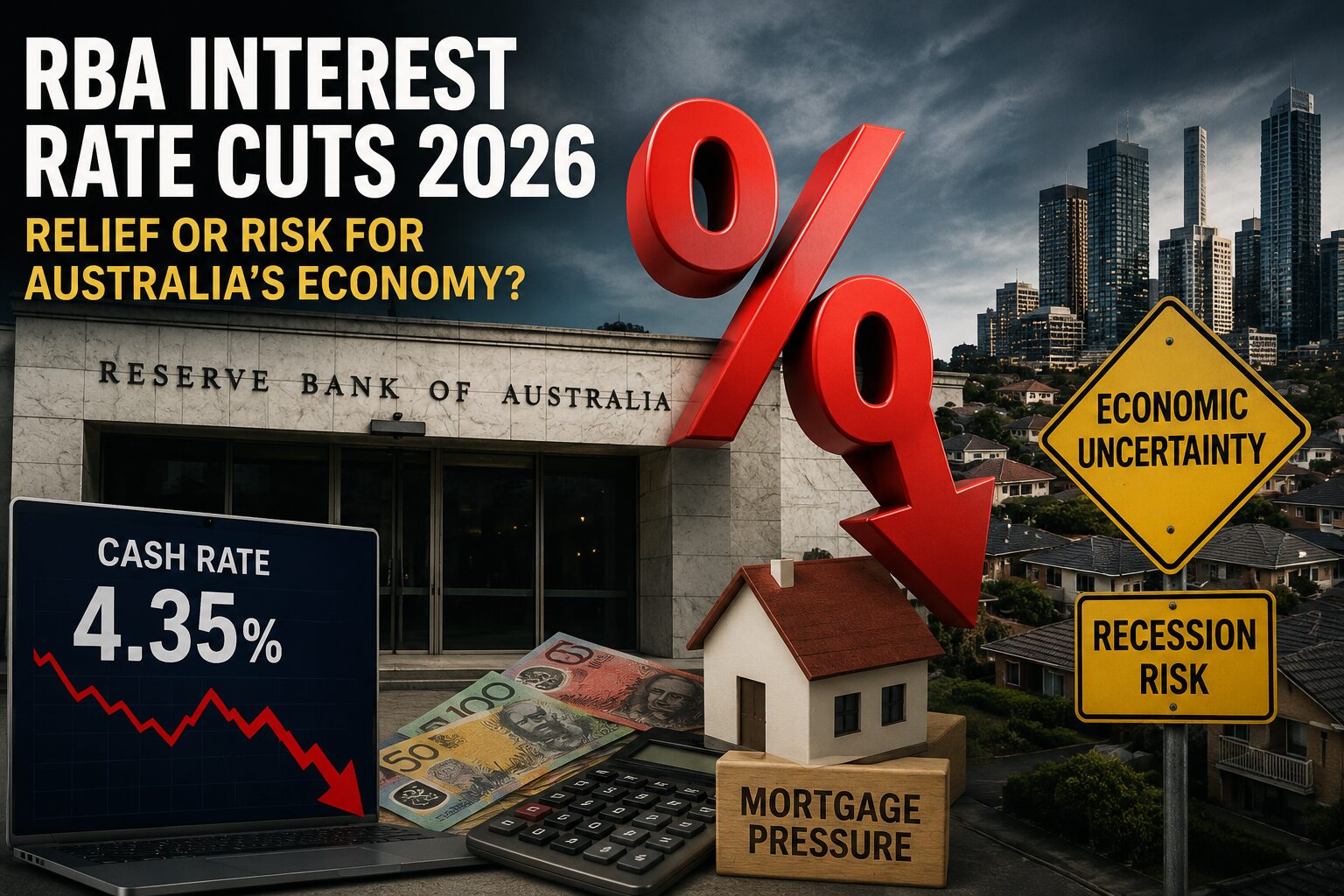
Australia’s economy is entering a dangerous phase in 2026. After several years of high inflation, rising mortgage repayments and weak household confidence, the Reserve Bank of Australia now faces a difficult question: should it cut interest rates to protect growth, or keep rates higher to control inflation?
Table of Contents
RBA Interest Rate Cuts 2026: Why Economists Are Calling for Action
The debate has intensified after warnings that the RBA could push Australia closer to recession if it waits too long to ease monetary policy. The current cash rate sits at 4.35%, after the RBA increased rates in May 2026 to fight renewed inflation pressure. But the economic signals are now mixed. Inflation is still above the RBA’s 2–3% target band, yet unemployment is rising, consumers are under pressure, and the housing market is cooling.
The latest Australian CPI data shows annual inflation eased to 4.2% in April 2026, down from 4.6% in March. That sounds positive, but the problem is that underlying inflation remains sticky. Trimmed mean inflation, which the RBA closely watches, was still 3.4%. This means price pressures have not fully disappeared, especially in housing, transport and food.
At the same time, the labour market is weakening. The unemployment rate rose to 4.5% in April 2026, with employment falling and the number of unemployed Australians increasing. This is one of the clearest warning signs that high interest rates are starting to bite. When businesses slow hiring and households cut spending, the economy can quickly lose momentum.
Could Australia Face a Recession if the RBA Delays Interest Rate Cuts?
This is where the RBA faces its biggest risk. Interest rates work with a lag. A rate hike today may not fully affect households and businesses for many months. Many Australian mortgage holders are still rolling off lower fixed-rate loans into much higher repayments. Renters are also under pressure, while small businesses face higher borrowing costs, wage pressures and weaker customer demand.
The argument for cutting rates is simple: if the RBA waits until the economy is clearly in recession, it may already be too late. A modest rate cut could ease pressure on mortgage holders, improve consumer confidence and reduce the risk of a sharper downturn. It could also support the construction sector, which is critical at a time when Australia already has a serious housing shortage.
However, cutting rates too early carries dangers. Inflation is still above target. If the RBA cuts before inflation is clearly under control, households and businesses may regain spending power too quickly, pushing prices higher again. A premature cut could also weaken the Australian dollar, making imports more expensive and adding fresh inflation pressure through fuel, machinery, electronics and other imported goods.
There is also a housing risk. Lower interest rates usually increase borrowing capacity. In a normal market, that can support activity. But in Australia’s supply-constrained property market, rate cuts could reignite house price growth without fixing the shortage of homes. That would be painful for first-home buyers and renters, especially if wages do not keep pace.
The biggest danger in the Australian economy is not one single shock. It is the combination of weak productivity, expensive housing, high household debt, rising unemployment and sticky inflation. Australia may avoid a technical recession, but many households already feel like they are living in one. GDP may grow on paper, yet GDP per capita can fall, meaning the average person feels poorer.
A smart RBA strategy would be cautious, not dramatic. The central bank does not need to slash rates aggressively unless unemployment rises sharply or economic growth collapses. But it should clearly signal that the next move could be down if inflation continues to ease and the labour market weakens further.
What RBA Interest Rate Cuts Could Mean for Homeowners, Investors and Borrowers
For households, the message is clear: do not assume rate cuts will solve everything. Even if the RBA cuts later in 2026, mortgage repayments are unlikely to return to the ultra-low levels seen during the pandemic. Australians should continue building emergency savings, reducing high-interest debt, comparing mortgage rates and avoiding lifestyle inflation.
For investors, the outlook is also mixed. Rate cuts could support shares and property, but recession fears could hurt company earnings and employment-sensitive sectors. Defensive budgeting and diversified investing remain important.
In conclusion, the RBA is walking a narrow path. Keep rates too high for too long, and Australia risks a deeper slowdown or recession. Cut too early, and inflation could return with force. The best outcome would be a gradual easing cycle supported by falling inflation, stable employment and stronger productivity. But in 2026, Australia’s economy is fragile — and the RBA’s next decisions may determine whether the country achieves a soft landing or slips into a painful downturn.